
SME sales strategy: which clients should you target first?
Trying to speak to everyone means convincing no one. Here is how to choose the segments where your offer has the best chance of winning.
BlogSales
A good discovery call is won by talking less than the prospect. The structure, the questions and the mistakes to avoid.


The discovery call is where the sale is won or lost, long before the proposal and long before the price. Yet it is the step teams prepare least. They rehearse the presentation, polish the slides and arrive in front of the prospect with one idea in mind: explaining what they do.
You should aim for the opposite. A successful discovery call is one where your prospect has talked far more than you. They have described their situation, what is stuck and what it costs them. By the end, you no longer need to convince them: they have stated for themselves why they need to act.
“Here is what I suggest: I ask you a few questions to understand your situation. At the end, either I see how I can help and I tell you, or it is not for you, and I tell you that too.” That sentence relaxes everyone. Your prospect knows nobody is going to force their hand.
“What made you want to talk about this now?” The answer gives you the trigger. It is often the most valuable piece of information in the meeting.

How do you work today? Since when? What have you already tried? Open questions, starting with how, what and since when.
This is the heart of discovery. “What does this cost you, concretely?” In time, in money, in lost clients. As long as the problem has no number on it, even a rough one, your price will always look high.
“If this were solved in six months, what would have changed?” The gap between the current situation and the desired one is exactly the space your offer fills.
As soon as the prospect mentions a need, the temptation is to jump to the solution. Resist. Every additional question makes your proposal more accurate.
Listen to the answer, rephrase, dig. “When you say it is complicated, what do you mean?” One good follow-up is worth more than a series of prepared questions.
“I’ll send you a proposal” is not a next step. A date, a topic, the people attending: that is a next step. Without it, you enter the cycle of follow-ups that get no reply.
Everyone knows they should listen. In the moment, facing a rushed or sceptical prospect, old reflexes come back. The only way to change them is to practise.
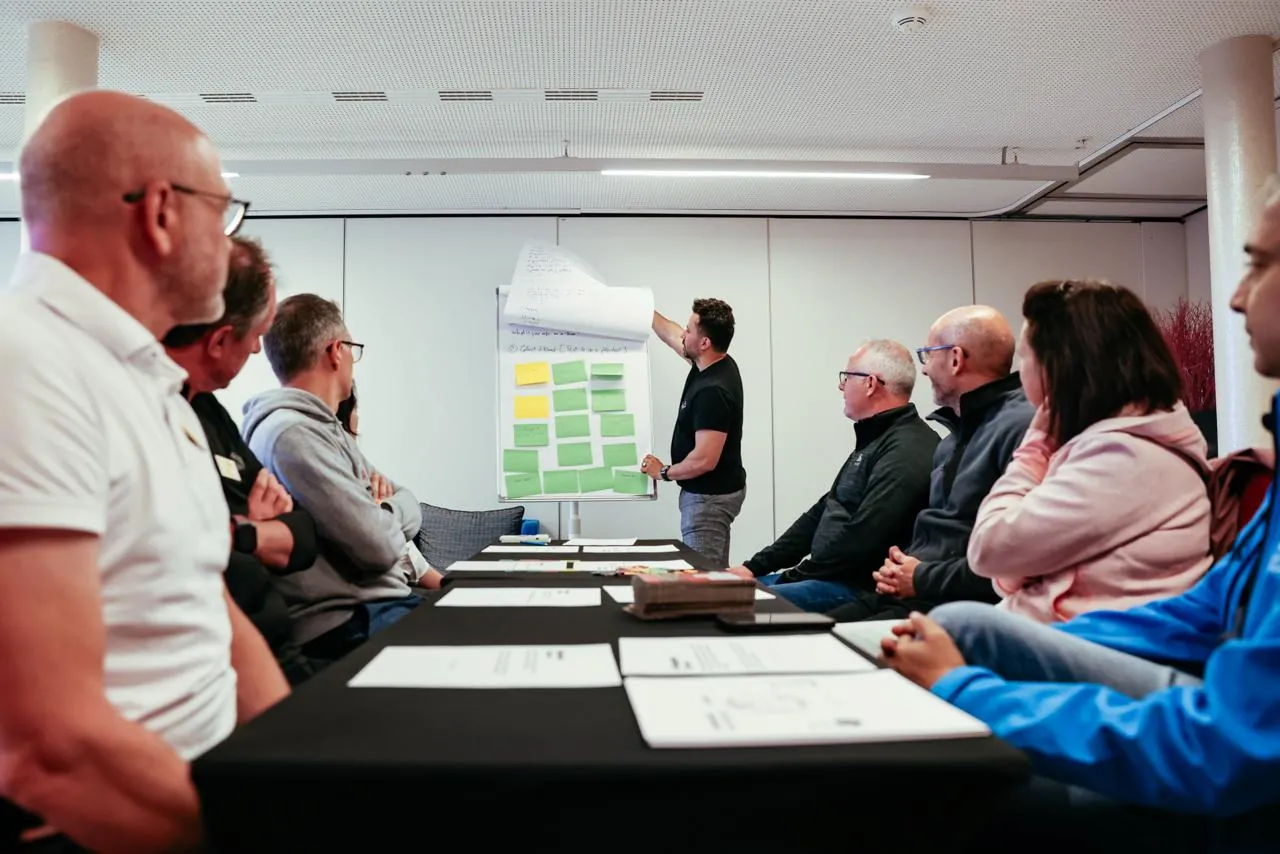
In the Sales performance in real situations workshop, your team brings its own meetings. I play the prospect and adapt my reactions as the scene unfolds. We observe the questions asked, the clarity of the proposal and how the next step is defined. Then everyone replays the conversation with one concrete adjustment.
Do you have a meeting that matters in the coming weeks? Rehearse it before you live it. That is the principle of corporate simulations: a real situation, a credible counterpart, a precise debrief.
Book a first 30-minute call and tell me about the meetings your team wants to lead better. We will choose the right sales workshop together.
Let’s talk about your situation.
A first 30-minute call to clarify your need and the format that would suit your team.
The author
Bertrand COMTE is a consultant, trainer and actor based in Lausanne. Founder of VitaMind, he works in-company in Lausanne, Geneva and across French-speaking Switzerland with executives, B2B sales teams and corporate programmes, in English and French.
Discover his backgroundRead next
 Sales
Trying to speak to everyone means convincing no one. Here is how to choose the segments where your offer has the best chance of winning.
 Sales
When all your clients come from your network, your business depends on luck. Here is how to choose two channels to test without spreading yourself thin.
 Sales
A sales plan that fits on one page and that the team actually applies: targets, message, channels, responsibilities.