
SME sales strategy: which clients should you target first?
Trying to speak to everyone means convincing no one. Here is how to choose the segments where your offer has the best chance of winning.
BlogSales
The moment you state your price lasts a few seconds and carries a lot of weight. How to prepare it, say it and hold the silence.


How to state your price to a client: many professionals who are excellent at their job lose their footing at that precise moment. The voice drops. The pace speeds up. They add “but we can discuss it” before the other person has even reacted. In a few seconds, they have undone the good work of the meeting.
I see it in almost every workshop. The problem is not the amount. It is the way it is said. A price stated with confidence sounds justified. The same price, stated apologetically, sounds negotiable.
Stating a rate feels like saying “this is what I am worth”. A refusal is then experienced as rejection. But your prospect is not judging you as a person. They are comparing an investment with an expected result.
“They will never have that budget.” You have no idea. Deciding on the client’s behalf is the first discount, the one you grant yourself.

A price given too early is compared with nothing, and therefore always too high. If you are asked in the second minute, answer frankly: “I am happy to give it to you. To give you the right figure, I need to understand a few points.”
Price comes after value. When the other person has estimated for themselves what their problem costs each month, your rate becomes a fraction of that amount.
“The full programme is this amount.” Full stop. No “roughly”, no “normally”, no “it depends”.
“To reach that result, with the workshops and follow-up we discussed, the investment is...” The price closes the sentence. It does not open it.
This is the hardest part. You state it, and you stop talking. The first person to speak after the price is generally the one who gives ground. Let the other person think.
Upfront payment, a longer commitment, a reduced scope, a testimonial: if you move, they move too.
Decide in advance how far you will go. A limit set with a cool head holds. A limit improvised under pressure collapses. For what comes next, see how to answer “it’s too expensive”.
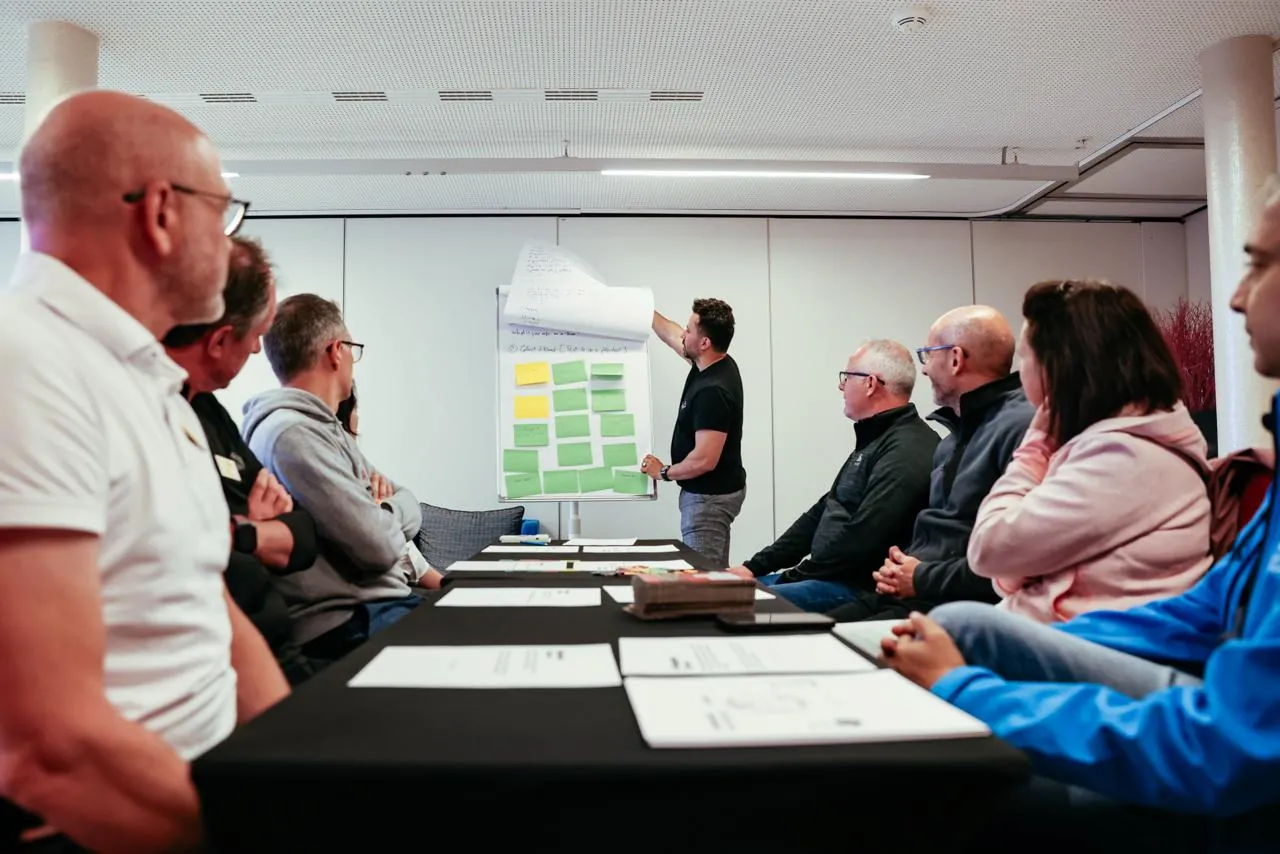
You do not become comfortable with your price by reading an article. You become comfortable by saying it out loud, several times, to someone who reacts. That is the principle of corporate simulations: you bring your next proposal, I play your client, we debrief, you replay.
For a whole team, the Sales performance in real situations workshop works on this moment with your real offers and rates. Book a first 30-minute call to discuss which business development format suits you.
Let’s talk about your situation.
A first 30-minute call to clarify your need and the format that would suit your team.
The author
Bertrand COMTE is a consultant, trainer and actor based in Lausanne. Founder of VitaMind, he works in-company in Lausanne, Geneva and across French-speaking Switzerland with executives, B2B sales teams and corporate programmes, in English and French.
Discover his backgroundRead next
 Sales
Trying to speak to everyone means convincing no one. Here is how to choose the segments where your offer has the best chance of winning.
 Sales
When all your clients come from your network, your business depends on luck. Here is how to choose two channels to test without spreading yourself thin.
 Sales
A sales plan that fits on one page and that the team actually applies: targets, message, channels, responsibilities.